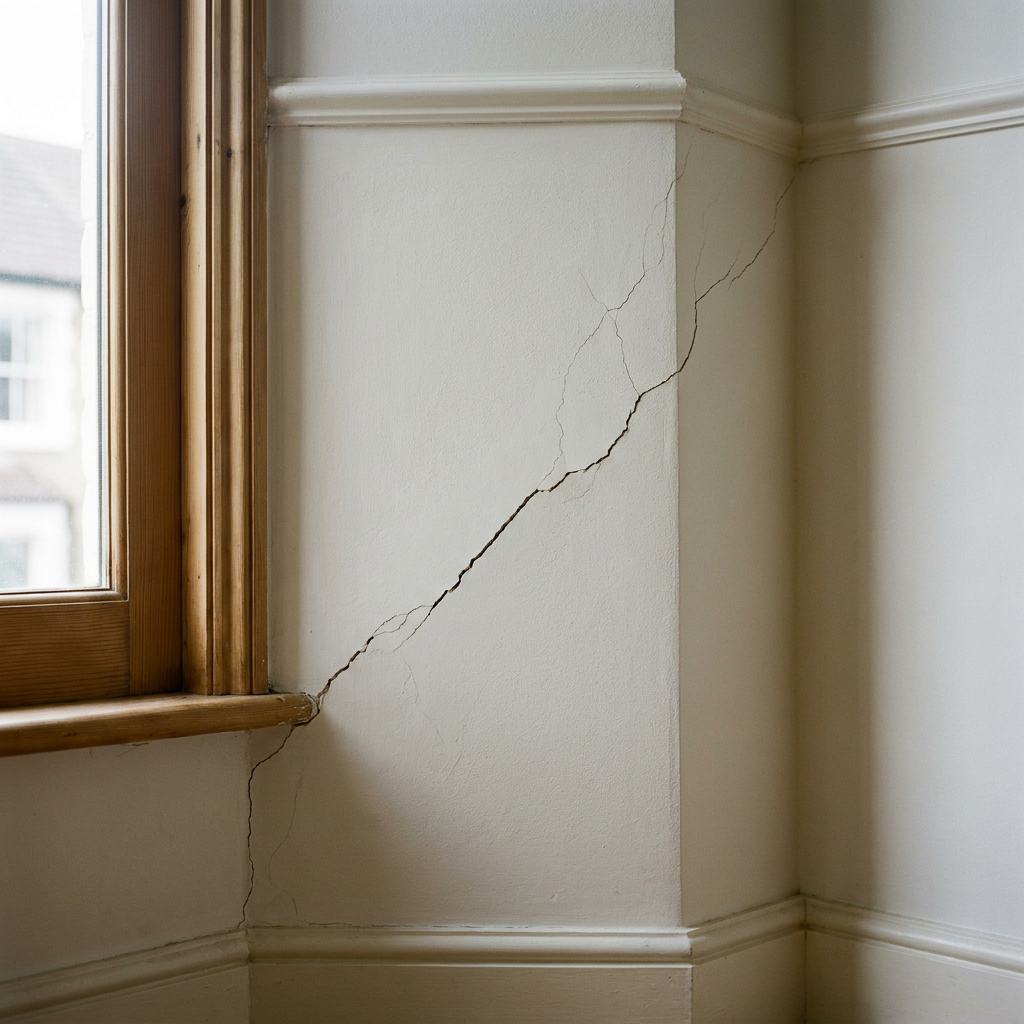
You have spotted a crack in a wall and your stomach has dropped. Take a breath. Many cracks in UK homes come from everyday causes such as plaster drying out, seasonal temperature changes, or movement that stopped long ago. Some do not. This post explains what the different kinds of crack can mean, what you can safely note down yourself, and when it is time to get an engineer to look.
This is general guidance on how houses usually behave. It is not advice on your home: I have not seen your property, and every house is different.
Key Takeaways
- Many cracks are cosmetic, from plaster shrinkage, temperature changes, or old settlement. Some are not, and the width alone does not tell you which.
- Engineers grade visible damage on the BRE Digest 251 scale, from category 0 (hairline) to category 5 (very severe). The category describes how bad the damage is, not what caused it.
- A crack that is getting wider, a crack you can see inside and outside at the same place, and doors or windows that have started to stick all need an engineer’s attention. So does any crack you are unsure about.
- “Subsidence” has several possible causes. Around Huddersfield, the ground is mostly Coal Measures and Millstone Grit rocks, often under clay-rich soils, with old mine workings and made ground in places. Leaking drains and trees matter too.
- Finding the cause of cracking needs someone at the property. Photographs help an engineer decide how urgent it is and what kind of visit is needed. They do not replace the visit.
- If you think it could be subsidence, read your buildings insurance policy. Most policies expect you to report it as soon as you reasonably can. Damage from old coal mining has its own claims route.
Why many cracks are not structural
Houses move a little all the time, with temperature, moisture, and the loads on them. Plaster is brittle, mortar ages, and timber dries out. All of that can produce cracks that carry no structural meaning.
The most common is plaster shrinkage. New plaster loses moisture as it dries, and fine cracks can appear within weeks or months, often at joints and corners. Brick, block, and stone walls also expand and shrink with temperature and moisture, so some fine cracks open a little in one season and close in another.
Older homes often carry cracks from settlement that finished long ago. A new building compresses the ground beneath it, and most of that happens in the first few years. The cracks it left can stay visible for the life of the house.
The difficulty is that a harmless crack and an early sign of ongoing movement can look alike on the day you find them. That is why the next section is about recording, not deciding.
What you can safely note down
Before you speak to anyone, it helps to record what you can see. Write the date on everything.
- Width. Measure it at its widest point with a crack-width gauge card (inexpensive and widely sold) or a ruler marked in millimetres. Note whether it is wider at the top or the bottom.
- Length and shape. Is it straight, diagonal, stepped along the mortar joints, or horizontal?
- Where it is. Near a window or door corner, where two walls meet, near a chimney, or low down near the floor?
- Inside, outside, or both. Can you see a crack in the same place on the outside of the same wall?
- What has changed. Doors or windows that have started to stick, gaps opening at skirting boards, or floors that feel out of level.
- Photographs. Take them square on, with the gauge or ruler held against the crack so the width can be read, and repeat them from the same spot every few weeks.
Please do not fill or decorate over a crack you are unsure about. Filling it hides the evidence of whether it is still moving, and that is the thing an engineer most needs to know.
Marking the two ends of a crack lightly in pencil, with the date, is a simple way to see whether it grows longer, and it does no harm. Treat it as a note for yourself, not a measurement: insurers and engineers will not rely on readings a homeowner has taken. Proper monitoring uses fixed gauges, installed and read by the engineer.
Reading the pattern
The shape and position of a crack are clues, not answers. As a general guide:
- Fine cracks in plaster only, at ceiling junctions or board joints, are often shrinkage.
- Diagonal cracks from the corners of windows and doors are common. They can come from small movements around the lintel, or from something more significant pulling that part of the wall.
- Stepped cracks along the mortar joints show that one part of the wall has moved relative to another. The question is why, and whether it has stopped.
- Cracks wider at one end than the other can mean part of the wall is rotating, which is one of the more telling signs.
- Horizontal cracks in a brick or stone wall can point to rusting wall ties in a cavity wall, a wall bowing outward, or pressure from ground behind the wall, such as a cellar wall or a house built into a slope. Cracks from rusting ties often repeat every few courses up the wall. They deserve an engineer’s attention.
- A crack you can see inside and outside at the same place suggests the movement has gone right through the wall, not just the plaster or the outer skin. That is a more significant finding.
The BRE Digest 251 damage categories
BRE Digest 251 gives engineers and surveyors a common language for how bad visible damage is. It grades damage from category 0 to category 5. The categories are based mainly on how easy the damage is to repair; the typical crack widths are a guide only.
- Category 0: hairline cracks, less than about 0.1 mm. Negligible.
- Category 1: fine cracks up to about 1 mm, easily treated during normal decoration. Very slight.
- Category 2: cracks up to about 5 mm, easily filled; some repointing may be needed outside. Doors and windows may stick slightly. Slight.
- Category 3: cracks of about 5 to 15 mm, or several cracks over 3 mm. Cracks may need cutting out and patching, and some brickwork replacing; doors and windows sticking. Moderate.
- Category 4: cracks of about 15 to 25 mm, though the number of cracks matters too. Extensive repair, possibly rebuilding parts of walls; floors sloping, walls leaning or bulging. Severe.
- Category 5: cracks usually over 25 mm. Major repair or partial rebuilding; risk of instability. Very severe.
Two things to keep in mind. First, the category describes the damage today, not the cause and not whether it is still moving. A 2 mm crack that is getting wider can matter more than a 6 mm crack that has not changed in years. Second, a wide crack that seems to have stopped still needs an engineer to look: it may have weakened the wall, or the movement may only have paused.
What can cause subsidence around here
Subsidence means the ground under the foundations has moved down, taking part of the building with it. The causes depend on the ground and what is happening in it.
Much of the national advice about subsidence is about shrinkable clay, as found across much of south-east England. Around Huddersfield and the rest of Kirklees, the rock is mostly mudstones, siltstones, and sandstones of the Coal Measures and Millstone Grit. In many places it is covered by clay-rich soil: weathered rock, material that has crept down slopes, glacial deposits in some areas, and river deposits in the valley bottoms. This ground is generally less prone to seasonal shrinking and swelling than the clays of south-east England, though it can still happen, especially near large trees. Other local causes matter more often:
- Leaking drains, which can soften or wash away the ground under a foundation. They are a common cause of cracking near bathrooms, kitchens, and downpipes.
- Old mine workings, which are found in parts of the district. A coal mining report, from the Mining Remediation Authority (the name the Coal Authority now operates under), can show whether a property is in an area affected by past coal mining.
- Made ground, meaning filled or tipped ground, which can keep settling long after it was placed.
- Trees on clay soils, especially large ones close to the house, where the ground can shrink as they draw water from it.
- Slopes, where ground can creep slowly downhill.
None of these is diagnosed from a photograph. Working out which, if any, applies means looking at the building, the ground around it, and often the drains.
Your insurer and your engineer
If you think your cracking could be subsidence, read your buildings insurance policy. Most policies expect you to tell the insurer as soon as you reasonably can about damage that could lead to a claim, and delay can cause problems later. Check your policy wording for the exact condition. Your insurer may appoint its own engineer or loss adjuster, and may monitor the cracks for some months before deciding what to do.
If old coal mine workings could be involved, the Mining Remediation Authority has its own subsidence claims process, which is separate from your insurance. You can contact them as well as your insurer.
You can still get your own independent engineer’s opinion. Your insurer may not pay for an engineer you appoint yourself, so check with them first if cost matters. If a claim is open or likely, tell the engineer before you instruct them. It affects what their report is for and who can rely on it, and some engineers, including me at present, do not take on crack or movement investigations that an insurer will rely on.
When to call a structural engineer
Speak to a chartered structural engineer if a crack is getting wider or longer, if it is wider at one end than the other, if a crack is wide, even if it seems to have stopped, if you can see it inside and outside at the same place, if doors or windows have started to stick, if you see horizontal cracking or bulging in a brick or stone wall, if cracks appear near a drain, a large tree, or a slope, or if you are simply unsure what you are looking at.
If you are buying a house with visible cracking, raise it with your surveyor before you commit; they may recommend a structural engineer. If your insurer has raised subsidence, you can still get an engineer’s opinion for your own decisions, as explained above.
Photographs and your notes help the engineer judge how urgent it is and what kind of visit is needed. Finding the cause needs someone at the property. Sometimes one visit is enough to give a clear opinion. Sometimes the honest answer after one visit is that the cracks need monitoring over several months before anyone can say whether they are still moving.
When it cannot wait
Some signs need action the same day: a crack opening quickly, a wall that has started to bulge or lean, or a bulge that is getting worse, a ceiling sagging, a chimney that has started to lean, a door or window that has suddenly jammed, or cracking or sagging after a wall has been taken out or building work has started. Keep people away, stop any building work, and do not try to prop or repair it yourself. Get a structural engineer to look as soon as you can, and if a builder is working on the house, ask them to arrange temporary support through their engineer straight away. If anything could fall onto a road or path, contact your council’s Building Control dangerous structures service. If collapse looks imminent or anyone is hurt, call 999. If you smell gas, leave the building and call the National Gas Emergency Service on 0800 111 999. If the ground suddenly opens up or sinks near your home, keep away. In a coalfield area, report it to the Mining Remediation Authority; if it is in a road or pavement, tell the council as well.
Need expert eyes on your project?
I am a Chartered Structural Engineer (CEng, MIStructE) based in Huddersfield. The Beam Doctor offers homeowners and builders:
- Defect investigation — I attend your property, inspect the cracking or movement, and give you a written opinion on the likely cause, or, where one visit cannot settle it, what monitoring or further investigation is needed. The site visit is included in the price. Monitoring, if it is needed, is priced separately. I take on a limited number of these, and I will confirm whether I can take yours once you have answered a few scoping questions. The report is for your own decisions. I do not take on reports that a lender, valuer, or buyer will rely on. At present I also do not take on reports that an insurer will rely on, or that are to be put to another party, such as a builder or neighbour, to establish what caused the damage. See the fee bands →
- On-site attendance — a Chartered Engineer at your property, tiered by duration. A brief verbal summary on site, then site visit notes within 2 working days: photographs, annotated sketches, and anything still needed for the design. The notes are a record of the visit, not a report. If you want to know what is causing a crack, Defect Investigation is the right service. See site visit fees →
- Steel beam (RSJ) calculations — Eurocode-compliant, Building Control-ready, 5 working days from acceptance and receipt of all the information needed. Desk-based, from the information you provide. See all services and current fees →
Current fees for every service are listed on the services page.
Leave a Reply